Leading a Team in 2026: AI Changed the Job, Not the Fundamentals
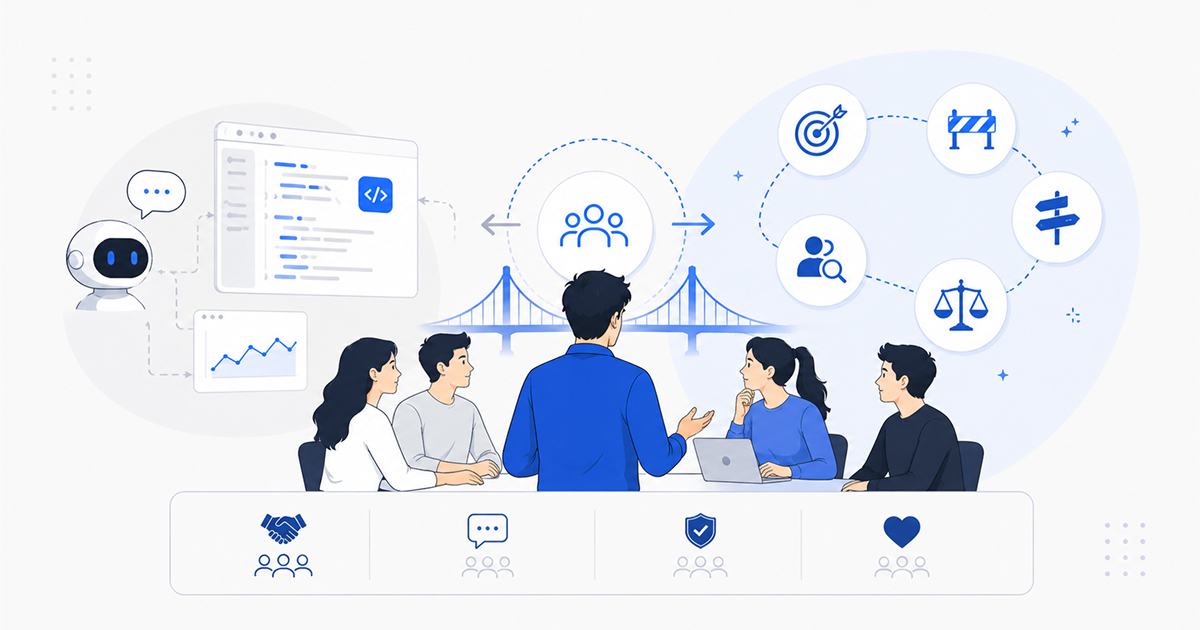
I lead a frontend team where everyone uses AI coding tools daily. Claude Code for architecture planning and code generation. Antigravity for inline assistance and refactoring. Codex for prototyping. Gemini, Claude and ChatGPT for research.
The conversation about AI in engineering leadership is dominated by two extremes: “AI will replace engineers” and “AI is just autocomplete.” Both are wrong. The reality, after sometime of leading a team that uses these tools in production, is more nuanced and more interesting.
What actually changed
Code review is harder. When a developer writes code by hand, you can see their thinking in the code, their naming conventions, their error handling patterns, their architectural instincts. When code is AI-generated, it arrives syntactically correct but often architecturally misaligned. It compiles, it passes tests, and it does the wrong thing elegantly. The reviewer’s job shifts from “does this code work?” to “does this code belong here?” which requires deeper architectural context and is harder to evaluate in a diff view.
The definition of “junior” changed. A junior engineer with Claude Code can now produce code that looks senior in terms of syntax, patterns, and test coverage. But they cannot evaluate whether the AI’s suggestion is the right approach for this specific system. The gap between “can write code” and “can make engineering decisions” widened. As a lead, I spend more time on decision-making mentorship and less time on syntax correction.
Prototyping is genuinely faster. When I conceived Nexus One at Avail, I had a working prototype within days instead of weeks. AI tools let me explore architectural options rapidly, generating three different component structures and evaluating each one rather than committing to the first approach and discovering its flaws later. This is a real, meaningful productivity gain for senior engineers who know what they want but need to iterate on how to build it.
Documentation improved. AI tools write excellent documentation. README files, inline comments, API descriptions, the tedious writing that engineers historically skipped is now generated in seconds and only needs review. Our codebase is better documented than it has ever been.
What did not change at all
Trust is still the foundation. No amount of AI tooling changes the fact that a team functions on trust, trust that your lead is making good decisions, trust that your teammates are pulling their weight, trust that the company will not implode next quarter. I built trust during the bear market by staying when others left and keeping the product alive. AI did not help with that.
Direction setting is still the leader’s job. AI can generate code for any specification you give it. It cannot tell you which specification to write. Deciding what to build, what to deprioritize, what to kill, these are human judgment calls that require understanding the business, the users, and the team’s capacity. No AI tool I have used can do this, and I do not expect one to anytime soon.
Hiring still matters more than tooling. A team of average engineers with the best AI tools will be outperformed by a team of great engineers with no AI tools. The tools amplify capability, they do not create it. I still spend significant time on hiring, interviewing, and evaluating candidates, and the criteria have not fundamentally changed: can this person reason about tradeoffs, communicate clearly, and ship under ambiguity?
Accountability has no AI shortcut. When a production incident happens, someone needs to own the response, communicate with stakeholders, and ensure it does not happen again. AI can help diagnose the issue faster, but the leadership, staying calm, making decisions under pressure, taking responsibility, is entirely human.
The uncomfortable middle ground
The honest position is uncomfortable: AI tools make individual engineers meaningfully more productive (I estimate 50-60% faster for well-defined tasks) while leaving the hardest parts of engineering leadership completely untouched. The leader’s job in 2026 is to help the team leverage AI for the 50-60% productivity gain while ensuring that the remaining 40-50% (the judgment, the architecture, the communication, the accountability) does not atrophy because everyone is leaning on AI for the easy parts.
The fundamentals of leadership did not change. The tools just raised the bar for what “the fundamentals” need to accomplish.
Written by Shrinath Prabhu, Senior Staff Frontend Engineer at Avail Project.